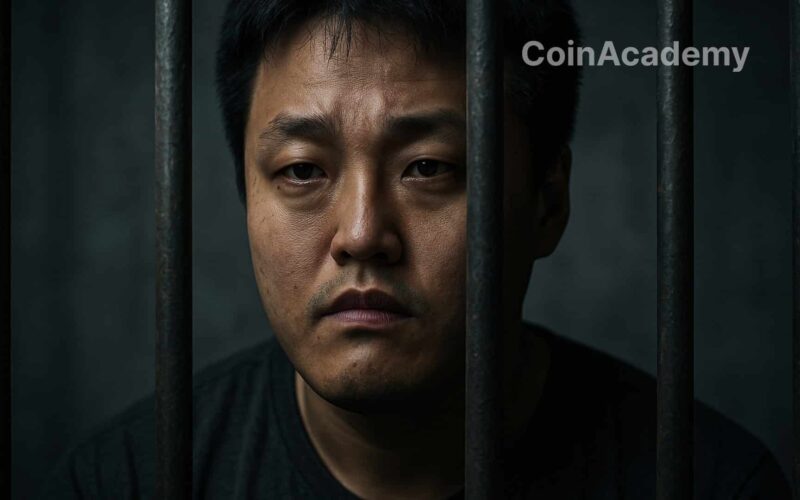
Do Kwon has been sentenced to 15 years in prison by a federal court in New York for fraud and conspiracy, a sentence exceeding the prosecutors’ request and far beyond the defense’s plea.
This decision judicially closes the Terra case, the collapse of which wiped out nearly $50 billion in May 2022.
The judge described the fraud as massive and morally aggravated, highlighting that Do Kwon publicly urged investors to remain exposed while project associates discreetly exited their positions. His international flight with false passports also heavily influenced the decision.
The judge surpasses the prosecutors’ request and sentences Do Kwon to 15 years
Do Kwon will spend the next 15 years behind bars. The co-founder of Terraform Labs was sentenced by a federal court in New York for fraud and conspiracy, bringing a judicial conclusion to one of the most devastating collapses in crypto history. In May 2022, the fall of the Terra ecosystem erased nearly $50 billion in just three days, triggering a chain reaction throughout the market.
The sentence handed down by Judge Paul Engelmeyer, from the southern district of New York, exceeds the prosecutors’ request, who sought 12 years, and crushes the defense’s plea, limited to five years. Do Kwon must serve at least half of his sentence before being eligible for a potential transfer to South Korea, where he remains exposed to further legal action.
A fraud judged massive and morally aggravated
During an emotionally charged and lengthy hearing, the judge emphasized the ‘staggering’ magnitude of the fraud, both in terms of lost amounts and the number of victims. Investors testified in person or by phone about the personal and familial consequences of the collapse of TerraUSD (UST) and Luna.
Engelmeyer also highlighted Kwon’s behavior during the critical phase of the final UST stablecoin de-peg. As he publicly urged individuals to stay invested, he and project associates began discreetly exiting their positions. Such conduct was deemed ‘despicable’ by the court.
The judge also recalled Do Kwon’s prolonged escape, passing through Serbia and Montenegro with false passports before his arrest as he attempted to reach Dubai. This fact weighed heavily in determining the sentence.
A dismissed defense, an embraced deterrence message
The defense’s plea for five years was deemed ‘completely inconceivable’ by Engelmeyer. According to him, such a lenient sentence would not only have been unjustifiable but also counterproductive in the face of the need to deter future similar schemes. Even the prosecutors’ recommendation was deemed insufficient to prevent the emergence of ‘future Do Kwons’.
The judge was particularly critical of the accused’s public communication, citing mocking messages posted on social media, including an iconic tweet in which Kwon stated he wouldn’t ‘debate with the poor’.
A strong symbol for the crypto industry
In August, Do Kwon pleaded guilty to conspiracy to commit fraud in commodities, securities, and electronic communications. He admitted to knowingly deceiving UST investors. At the time, he theoretically faced up to 135 years in prison, a sentence reduced to a maximum of 25 years after an agreement with the prosecutors.
Do Kwon’s conviction is part of a significant legal sequence for the industry. Sam Bankman-Fried is already serving a 25-year sentence for the FTX collapse, while Alex Mashinsky, founder of Celsius, received a 12-year sentence. The message sent by the US justice system is clear: fraud remains fraud, even in the crypto ecosystem, and prominent figures will no longer receive any leniency.