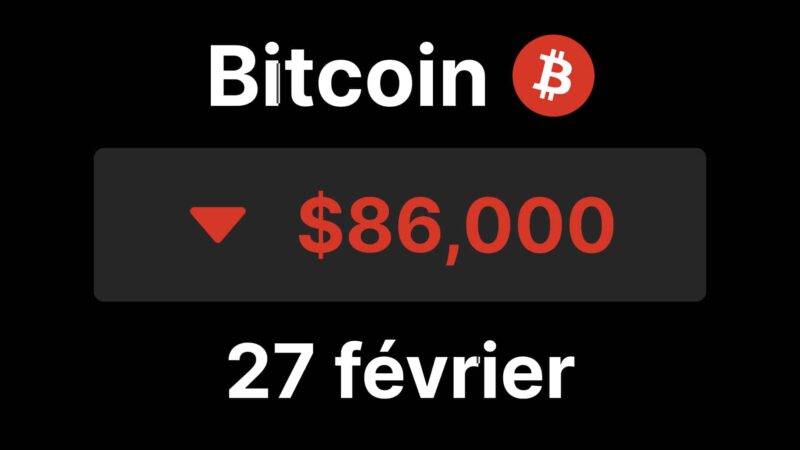
Bitcoin briefly dipped below $86,000 on Monday evening amidst a global retreat in risky assets, only to bounce back above $87,000 on Tuesday afternoon. This typical end-of-year sequence sees liquidity shrinking, allowing any macro shock to amplify moves without immediately challenging the underlying structure.
At its lowest, BTC fell to around $85,300, down about 4.4% over 24 hours. Ethereum suffered more with a 6.5% drop below $2,900, while other major altcoins like XRP, Solana, and BNB followed suit, shedding between 4% and 7%. Since then, the market has partly stabilized, with bitcoin reclaiming ground and nearing $88,000 after the US November employment figures were released, showing no real risk appetite resurgence.
A Macro Movement, Not a Specific Crypto Crash
Analysts believe the decline isn’t tied to a sector-specific event. Rick Maeda from Presto Research points out that the selling pressure coincided with the opening of the US stock markets, which fell right from the start. The Nasdaq lost nearly 0.6%, the S&P 500 saw a slight decline, dragging risky assets, including crypto, down with it.
Liquidity dries up as the holidays approach, making movements more pronounced, especially during US market hours.
The year-end setting plays a crucial role.
In such an environment, relatively modest flows are enough to trigger cascading sales.
Fed’s Move Did Not Reassure the Markets
The drop comes a few days after the Fed’s third rate cut this year, a 25 basis point adjustment that failed to impact sentiment as expected. According to Vincent Liu, CIO of Kronos Research, the monetary easing just marginally shifted the needle in the face of a deemed uncertain macro environment.
With gradually leveraged position unwinding and increasingly thin liquidity, each dip turned into a more pronounced slide. The likelihood of a ‘Santa rally’ for bitcoin diminishes as prices struggle to sustainably break resistance levels tested after the Fed’s decision.
Chinese Trail Resurfaces, No Evidence of Massive Sales
Behind the scenes, some have mentioned a new wave of mining crackdown in China, particularly in the Xinjiang region. According to Jianping Kong, president of Nano Labs, up to 400,000 machines may have been taken offline recently, resulting in an estimated 8% drop in the network’s hashrate.
While such news can temporarily impact sentiment, there is no indication of significant bitcoin sales by the affected miners. Short-term outlook hinges on the upcoming US inflation data. As long as macro visibility remains limited, bitcoin may continue to move within wide ranges, alternating between stress and technical rebounds.